



What do you need to choose the right screws?
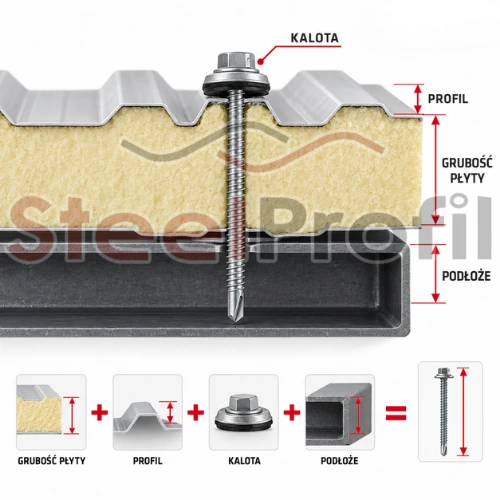
Sandwich panels need dedicated screws suited to the supporting structure, panel thickness, substrate thickness and corrosive conditions. Steel and timber require different fasteners; concrete needs a system with a predrilled hole. Panel thickness alone does not determine screw length: check the specific fastener’s clamping range and drilling capacity. The design, wind loads and connection capacity determine quantities. Correct installation requires a perpendicular screw and properly compressed EPDM washer. This guide explains the main selection factors, wall and roof fixing positions, example quantity calculations and common mistakes. SteelProfil offers screws for wall and roof sandwich panels.
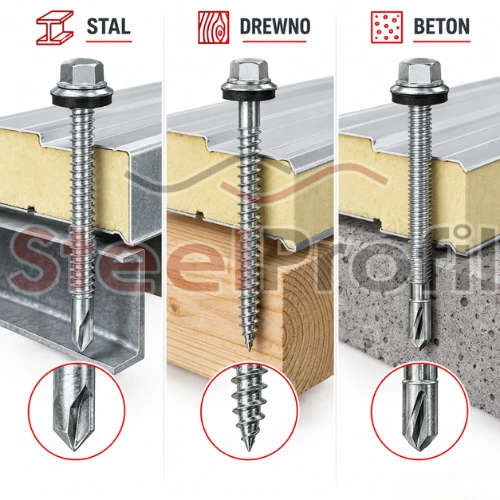
Which screws are used for sandwich panels?
Start with the substrate, rather than panel thickness alone. The same panel may be fixed to a steel rail, timber structure or concrete base, but each needs a suitable fastener type.
Steel structures use dedicated self-drilling or self-tapping fasteners. Where drilling is required, the screw’s drilling capacity must match the steel thickness: a thin-walled cold-formed section differs from a thicker steel purlin. Timber requires the correct thread and embedment depth. Concrete and reinforced-concrete substrates use specialist fixings with a predrilled hole.
SteelProfil offers steel-structure screws in various lengths and drilling capacities, plus separate timber fixings. Confirm the panel and substrate specifications before ordering; “screws for a 100 mm panel” is not enough information for a safe selection.
Where are roof-panel screws installed?
Follow the instructions for the specific roof-panel system. Many systems fix through the crest of the trapezoidal profile, with a matching saddle washer under the screw head.
The saddle washer distributes pressure over a larger area, stabilises the fixing and helps transfer forces, including those caused by wind. It must match the panel profile: an arbitrary washer will not provide the correct support.
Do not automatically apply ordinary trapezoidal-sheet fixing rules to sandwich panels. A roof panel is a complete insulated building-envelope element, and its fastening affects both weather tightness and safety.
How many sandwich-panel screws are needed?
For an initial calculation, use:
Number of panels × supports per panel × screws per support
Some manufacturers specify at least 2 screws per support for each panel. This is not a universal value for every building.
Wall example
10 panels, each supported by 3 rails, with 2 screws per support: 10 × 3 × 2 = 60 main screws.
Roof example
10 roof panels, each supported by 4 purlins, with 2 screws per support: 10 × 4 × 2 = 80 main screws.
Roof edge and corner zones can experience greater wind suction and may require 3 screws per support or more. Some manufacturers describe 2 fixings in less-loaded zones and 3 in more exposed areas for many typical cases. Final selection still depends on span, wind, structure and fastener capacity.
Where are wall-panel screws installed?
Wall panels may have exposed or concealed fixings. With exposed fixings, the screw passes through the facing into the structural member and its head and washer remain visible. Coloured heads can help match the facing.
With concealed fixings, the fastener sits within the joint and is covered by the next panel. The manufacturer may specify a load-spreading plate to reduce the risk of distortion or damage around the joint. Do not change the fixing arrangement yourself; follow the solution specified for the panel model.
What does the EPDM washer do?
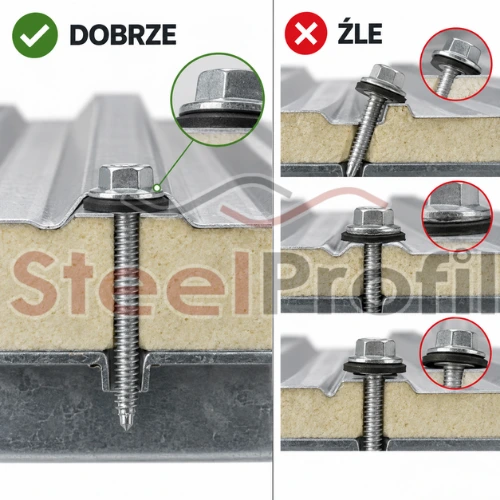
The EPDM washer seals the point where the screw passes through the outer facing. It is usually bonded to a metal washer.
It should bear evenly against the surface. It must neither remain loose nor be compressed so much that rubber is pushed out from under the metal washer. Too little tightening can leave a path for water; too much can damage the seal, distort the facing or harm its coating.
Common purchasing and installation mistakes
Common errors include choosing a screw from panel thickness alone, overlooking substrate thickness, insufficient drilling capacity, using the same model for timber and steel, and assuming a random quantity per panel.
Installation errors include driving screws at an angle, overcompressing EPDM washers, omitting required roof saddle washers and using a screw gun without a depth stop.
Remove metal swarf after drilling and cutting. Left on the coating, it can corrode and leave lasting marks. Fasteners transfer loads, stabilise the building envelope and seal fixing points; they are an essential part of the system.
Ask about materials for your project
Tell us which material you need, the quantity and delivery location. The SteelProfil team will help prepare an offer for your inquiry.
Phone: +48 500 409 109
REQUEST A QUOTE!


