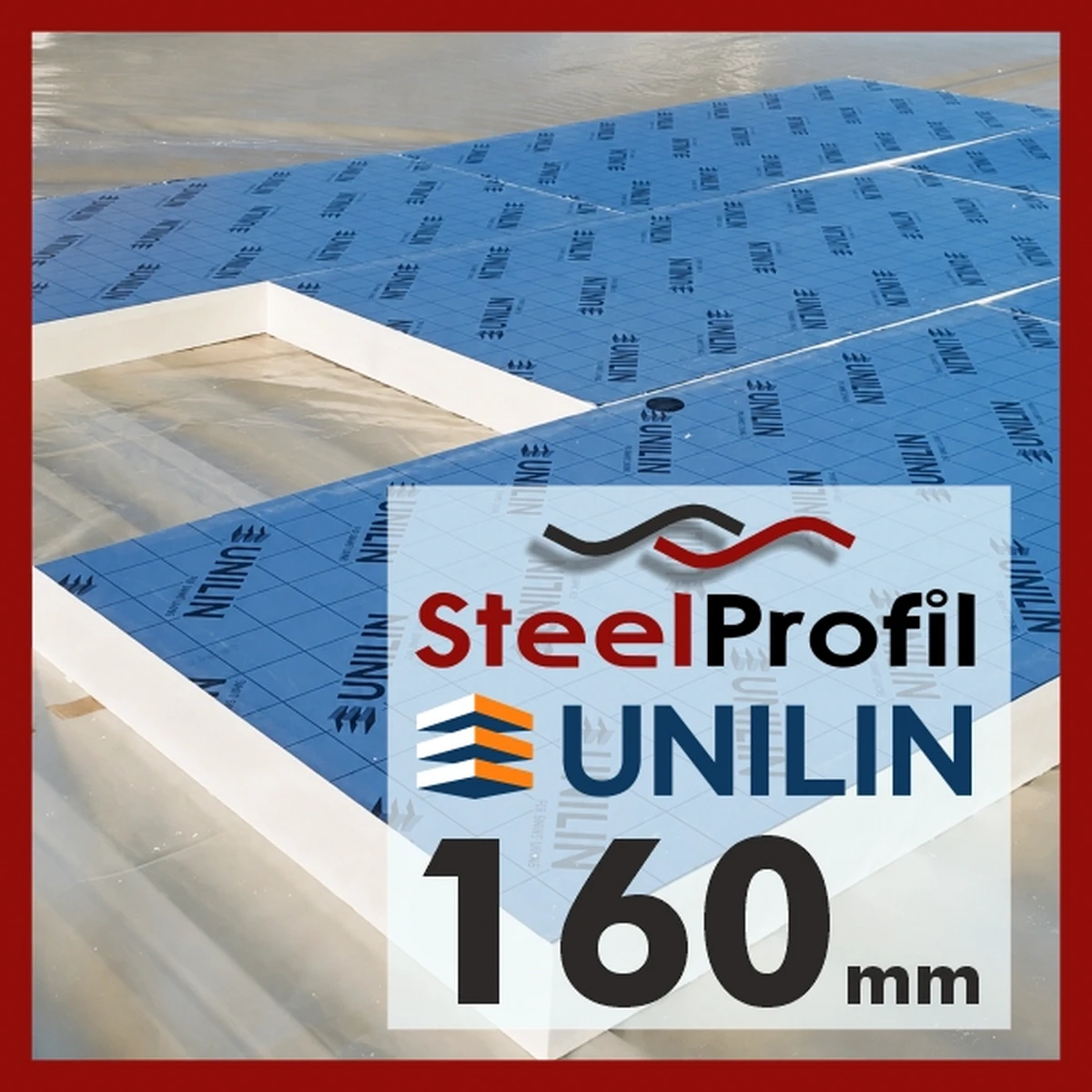



PIR boards can provide similar thermal resistance to EPS with a thinner insulation layer because their thermal conductivity is lower. The required thickness depends on the declared lambda values of the actual products. For example, PIR at 0.022 W/(m·K) needs about 61 mm to match 100 mm of white EPS at 0.036 W/(m·K), before rounding up to an available board thickness. This guide compares white and graphite EPS, explains the calculation and distinguishes the resistance of an insulation layer from the U-value of a complete wall, floor or roof. Suitability for the intended application must also be checked.


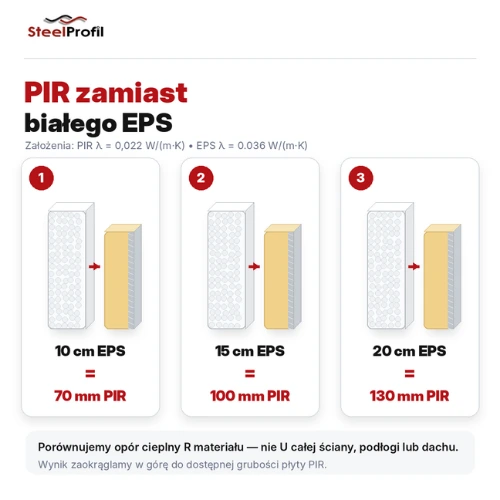
PIR instead of white EPS
For white EPS with a declared lambda of 0.036 W/(m·K) and PIR at 0.022 W/(m·K), 1 cm of PIR provides approximately the same thermal resistance as 1.64 cm of EPS. Round the calculated result up to an available board thickness.
| White EPS, λ 0.036 | Calculated PIR thickness | Example practical PIR thickness |
|---|---|---|
| 10 cm | About 61 mm | 70 mm |
| 15 cm | About 92 mm | 100 mm |
| 20 cm | About 122 mm | 130 mm |
Why not 60 mm of PIR for 100 mm of EPS? The source example gives a declared resistance of about 2.70 m²K/W for 60 mm PIR at λ 0.022, while 100 mm EPS at λ 0.036 gives approximately 2.78 m²K/W. The thinner PIR layer would be slightly less insulating. The 70 mm example gives about 3.15 m²K/W and retains a margin. Apply the same upward-rounding principle to 150 and 200 mm of EPS.
These comparisons concern the insulation materials alone. They do not confirm the U-value of a complete wall, floor or roof, which also depends on the structure, thermal bridges, board joints and other layers.
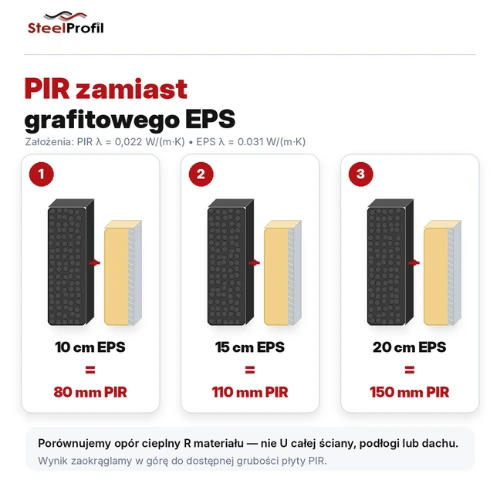
PIR instead of graphite EPS
Graphite EPS insulates more effectively than standard white EPS. For graphite EPS at λ 0.031 W/(m·K), 1 cm of PIR at λ 0.022 is equivalent to about 1.41 cm of EPS. The thickness saving is therefore smaller than in the white-EPS comparison.
| Graphite EPS, λ 0.031 | Calculated PIR thickness | Example practical PIR thickness |
|---|---|---|
| 10 cm | About 71 mm | 80 mm |
| 15 cm | About 106 mm | 110 mm |
| 20 cm | About 142 mm | 150 mm |
This shows why “PIR needs half the thickness of EPS” is too broad a statement. The difference depends on the lambda values of the specific products.
Thickness is not the only consideration. Façade, floor and roof EPS can have different mechanical properties even where lambda values are similar. Floors require suitable compressive strength; roofs require compatibility with the roof build-up; façades require appropriate fixing and approval for the system. Replacing EPS with PIR must suit the application, rather than just a thickness calculation.
How to calculate equivalent PIR thickness
Step 1: calculate the original material’s thermal resistance
R = d ÷ λ
- R is thermal resistance in m²K/W.
- d is material thickness in metres.
- λ is declared thermal conductivity in W/(m·K).
For 150 mm of white EPS at λ 0.036: 0.15 ÷ 0.036 = 4.17 m²K/W.
Step 2: calculate the PIR thickness
d PIR = R × λ PIR
4.17 × 0.022 = 0.0917 m, or about 92 mm. If a 92 mm board is unavailable, choose the next suitable thicker size; the example uses 100 mm.
The shorter form is:
PIR thickness = EPS thickness × PIR lambda ÷ EPS lambda
The calculation compares insulation-layer resistance. It does not confirm the U-value of the whole building element. Rafters, steel members, gaps at joints, screeds, masonry and structural boards can affect the result. Confirm a material substitution with the designer or person responsible for the thermal calculations.
Thinner PIR can help limit floor build-up, preserve loft space or reduce the depth of window reveals. Space savings alone should not decide the choice: first check the thermal and mechanical properties and the intended use of the board.

Choosing PIR for a roof, floor or wall
Converting an EPS thickness to PIR is only the first step. Check that the selected board is intended for the proposed application.
Floors: compressive strength matters. The board must support the loads from the floor build-up, equipment and users. PIR products do not all have the same strength.
Roofs: choose a product suited to a flat or pitched roof, allowing for fixing, waterproofing and condensation risk. Above-rafter boards may have tongue-and-groove edges, while other products have straight edges.
Walls: check whether the board is intended for an external wall, ventilated façade or internal insulation. Facings, edges and fixing methods may differ.
SteelProfil offers PIR boards with different facings, sizes and thicknesses, including first- and second-grade stock. Confirm thickness, quantity and collection location before travelling, as branch stocks can change. Selected boards are available for warehouse collection across seven locations once availability is confirmed.
Ask about materials for your project
Tell us which material you need, the quantity and delivery location. The SteelProfil team will help prepare an offer for your inquiry.
Phone: +48 500 409 109
REQUEST A QUOTE!