At a glance
Trapezoidal steel sheets can provide an economical roof covering when the chosen product suits the structure, exposure and roof details. Profiles, sheet thicknesses and protective finishes vary, as do the overall and effective covering dimensions. These differences matter as much as the purchase price. This guide explains the principal material and coating options, how profile names should be checked against product drawings, and how to calculate quantities using cover width. It also preserves dated price examples from January 2023 while making clear that roof pitch, loading and present availability require the specification and quotation for the actual project.
Materials, finishes and profiles
The source described sheet-thickness examples from 0.4 to 1.5 mm across different products. That is not a recommended thickness range for every roof. The design and exact product determine the required thickness.
- Galvanised steel: used in many cladding applications. Any later painting must use a compatible preparation and coating system.
- Aluminium-zinc-coated steel: a different metallic protection system whose suitability depends on its documented exposure conditions.
- Organically coated steel: polyester and other finishes can add colour and protection over the specified metallic coating.
- Profiled aluminium: a separate material option, also available with specified coloured finishes.
Profile examples in the source were T6, T7, T12, T14, T18, T20, T35, T45 and T55. The number often relates to nominal profile height, but confirm the actual drawing: similarly named profiles can differ in geometry and cover width. Profile height and metal thickness are different dimensions.
GET A QUOTE FOR STEEL SHEETS!
Suitability and historical prices
Cost and convenient sheet formats can favour trapezoidal roofing, particularly over large areas. The covering must still meet the roof’s loading, support and weathering requirements. The source’s 9% slope example is not a universal minimum pitch; use the exact product’s restrictions and detailing requirements.
The article of 13 January 2023 gave these historical price examples:
- Second-grade sheets from about PLN 15 net, described as below PLN 20 gross. The sentence did not state the sale unit clearly, so it must be confirmed rather than inferred.
- Approximately PLN 30 for a selected colour or higher-quality option, again without a clear unit or tax basis in that sentence.
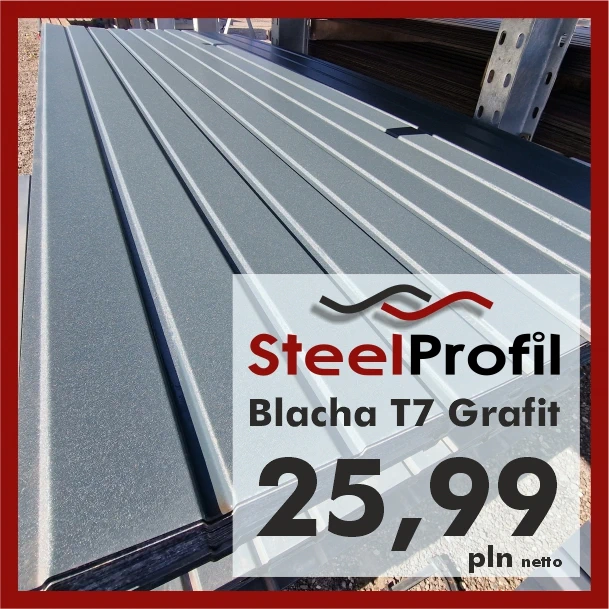
- First-grade polyester-coated sheets at PLN 40–50/m².
- Unpainted low-profile galvanised sheet from PLN 20/m².
- Wood-effect T7 soffit sheet at PLN 50–70 per metre; the source did not identify that metre as linear or square.
Unspecified tax bases and units are not filled in by assumption. These figures are not current offers. Source lifespan examples of several decades or up to 50 years also cannot establish the service life of a particular roof. Verify product, finish, environment and warranty.
Even a temporary shed needs a suitable sheet specification. A low purchase price or second-grade label does not prove adequacy.

Calculate using effective cover dimensions
Start from the roof layout, including slopes, lengths, junctions and overlaps. Overall width includes material used in the side lap; effective cover width is the dimension that contributes to the covered area. Check the product drawing rather than subtracting a guessed overlap.
Made-to-length sheets have product-specific limits. The source mentioned examples around five metres for thinner sheets and longer lengths for other profiles. Actual permitted lengths also need to suit handling and transport, not simply the sheet thickness.
Domestic and international manufacturers offer many profiles and finishes. Compare documented requirements and the current quotation for the exact product, including accessories and waste. The choice should follow the intended use, not a generic brand ranking.