



How to match new sheets and flashings to an existing roof
A leaking metal roof does not always need a completely new covering. A roofer should first identify the source of moisture and the extent of the work, including whether condensation is involved. If only part of the roof needs replacing, the new sheets and flashings must fit the remaining covering. Check the manufacturer, exact profile, coating and dimensions before ordering. A matching colour alone is not enough. This guide explains how to prepare for a repair assessment, compare the full cost of the work and supply the specifications needed to request suitable materials from SteelProfil.
For a partial replacement, the question is not simply how many metres you need, but whether the new component will fit what remains on the roof.
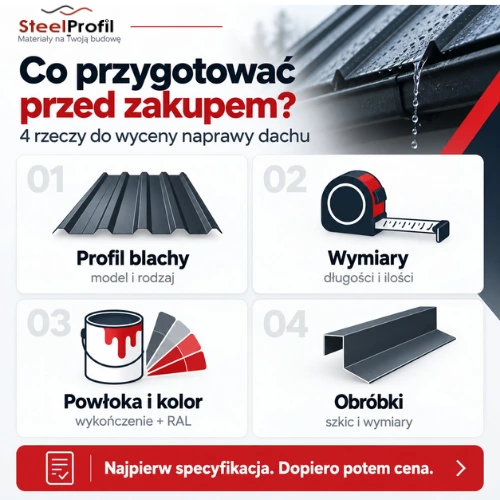
Start by identifying the manufacturer and exact model of the covering. Look for an invoice, product data sheet or delivery label. If these are unavailable, ask the contractor for measurements and photographs of the sheet profile. Do not order on the basis of the general description “trapezoidal roof sheet”. The specific product documentation sets out its geometry, effective and overall widths, thicknesses and installation requirements.
The same colour does not mean the same coating. Check the finish and its properties: polyester and polyurethane coatings, for example, are available in matt and gloss versions. A RAL number alone is not a complete product specification.
For flashings, ask the contractor for a drawing showing dimensions, bending angles, lengths and the visible face. Do not assume a new flashing should copy the old one exactly; first establish whether the original detail was correct. Send the drawing for quotation along with the sheet schedule.
SteelProfil supplies trapezoidal steel sheets and manufactures flashings. Send the specification agreed with your contractor to ask about suitable materials and completing the order. Stock availability does not replace confirmation of suitability: establish compatibility first, then agree collection.
Does the entire roof covering need replacing?
A leaking metal roof does not always require complete replacement. A roofer should determine whether the problem affects an individual component or a larger part of the roof. Moisture can also result from condensation; sealing joints alone will not address that cause.
Before buying materials, agree the scope of repair, check whether replacement parts can be matched and compare the full cost of the work.
SteelProfil offers trapezoidal steel sheets, flashings and roofing accessories. Confirm availability at one of the seven locations. Diagnose the problem before ordering, so your purchase is based on an assessment rather than a guess.
A local repair or a new roof covering?
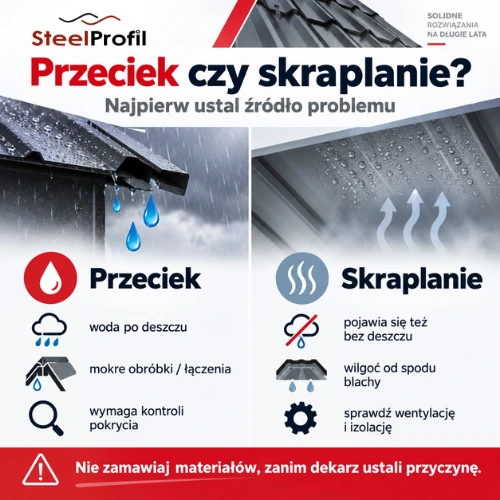
If you notice water in a garage, industrial building or loft, do not start by ordering new sheets. Arrange an inspection. Ask the contractor to identify the source of moisture, the condition of neighbouring components and the necessary work. This distinguishes a local defect from a problem affecting a larger area. Roofing manufacturers recommend professional advice before deciding between repair and replacement.
A local repair may be appropriate where damage is limited and the surrounding components remain sound. Examples include replacing damaged fasteners or repairing a small area of coating. This does not mean every leak can be solved with a new screw or sealant: the work must follow an assessment of the particular roof.
A wider refurbishment may be needed where deterioration is extensive or affects the supporting layers and structure. In that case, sheets may represent only part of the required materials. Check the condition of the components that will support the new covering. A structural engineer should assess a weakened structure; new sheets do not repair inadequate support.
Note when moisture appears: during rain, after snowmelt or also in dry weather. Condensation on the cold underside of sheets can occur without a leak in the covering. Ventilation, moisture sources and the insulation arrangement may then require assessment. Replacing sheets with similar ones without addressing the problem can leave its cause unchanged.
Prepare photographs taken from a safe position and documents from the previous purchase. Do not climb onto the roof yourself to find a hole or measure a sheet. Roof inspections require suitable fall protection, and an existing covering must not be assumed to support a person’s weight.
Comparing repair costs and avoiding unnecessary materials
The price per square metre of sheet is not the cost of repairing a roof. Labour, the chosen covering, roof complexity and location also affect the total. A reliable quotation should follow an inspection, rather than use the building area alone.
Ask for separate costs for materials, labour, transport and unloading. Check whether the material list includes flashings, fixings and seals as well as sheets. Ask about removal, preparation of the supporting surface, installation and any extra work discovered after opening up the roof. Agree how such changes will be approved.
For example, a roofer may identify one wall flashing for replacement and confirm that the adjacent covering is sound. The starting point is then a quotation for that repair, rather than sheets for the whole building. If the assessment shows broader damage, ask why more extensive replacement is necessary. This illustrates a decision-making process; it is not a diagnosis of a particular roof.
If the contractor considers more than one solution suitable, ask for a comparison. Establish what stays, what is replaced and what limitations remain with the less expensive option. A temporary protective measure and a complete repair are different services and should be compared accordingly.
Ask about materials for your project
Tell us which material you need, the quantity and delivery location. The SteelProfil team will help prepare an offer for your inquiry.
Phone: +48 500 409 109
REQUEST A QUOTE!

