At a glance
Trapezoidal steel sheets combine a profiled shape with a choice of protective finishes and dimensions. They can provide roof or façade cladding for suitable residential, agricultural and industrial buildings. Their performance depends on the exact steel sheet, profile, coating, supports and fixings, rather than on one general description of the material. This guide explains the distinction between steel thickness and coating, how to choose dimensions and profile height, and why load requirements and installation details must be checked together. It also retains the original article’s stock-length examples as historical information rather than a current availability promise.
Steel thickness, coating and dimensions
The steel substrate and its protective coating are different parts of the product. Steel thickness and profile geometry contribute to mechanical behaviour; a zinc or other specified coating protects the surface against corrosion under its stated conditions. A thicker coating does not replace the required steel thickness or structural design.
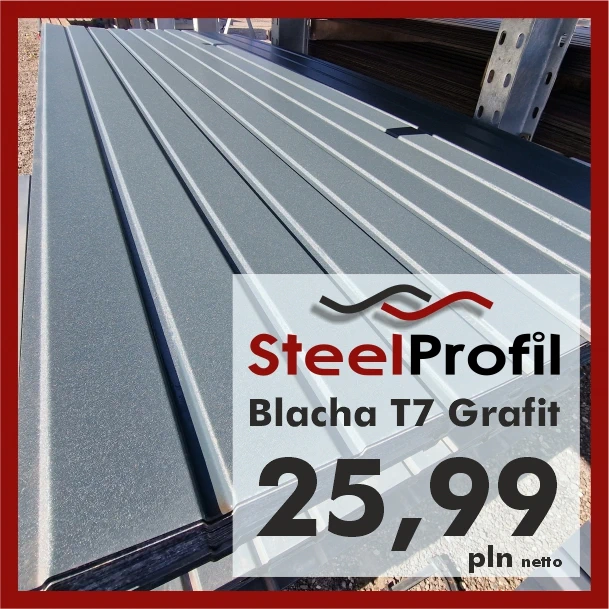
Sheets come in different widths and lengths. The original offer of 9 January 2023 listed ready-stock lengths of 2, 2.5, 3, 3.5 and 4 metres, alongside made-to-length sheets. Confirm present availability and the effective cover width before calculating an order.
Roofing screws and other fixings must suit the sheet, supporting material and intended service. Corrosion resistance and sealing are required product characteristics, not properties to assume for every screw.
GET A QUOTE FOR STEEL SHEETS!
Roof and façade applications
Trapezoidal steel sheets can be used on suitably designed outbuildings, warehouses, industrial halls and residential buildings. A tent-hall or other lightweight structure needs a specifically designed cladding and support arrangement; sheet cladding cannot simply be added without checking the structure.
The profile, thickness, finish and colour can be selected for the building. Roof sheets and façade sheets may have different details. A tile-effect roofing sheet is a separate profiled product when the desired appearance resembles traditional tiles.
Durability and colour choice
Galvanising and additional coatings can provide useful corrosion protection, but service life also depends on exposure, cut edges, detailing, installation and maintenance. The material is not immune to mechanical damage, and no single finish satisfies every environment.
Compare available colours alongside the documented performance of the exact coating. Appearance, substrate thickness and corrosion protection are separate selection criteria. Product choice should meet the project requirements rather than rely on a general claim that one sheet is the most durable on the market.

Choose the profile using the actual loads
Profile geometry affects sheet stiffness. Snow, wind and other relevant loads, the support arrangement, steel thickness and fixing pattern all influence the required specification. A higher profile can be one design option, but simply choosing a taller profile is not a complete load check.
Use the manufacturer’s data for the exact sheet and span arrangement. Roof and façade loads are not interchangeable, and a profile name is not a permitted-load value.
Installation and ordering
Follow the product’s requirements for supports, fixings, laps and flashings. Protect the coating during handling and complete the junctions carefully. Suitable installation and subsequent inspection help the cladding perform as intended.
Order against a roof or wall layout using the effective cover dimensions, not only the overall sheet size. Confirm whether ready-stock or made-to-length sheets best suit the project, together with the current price, accessories and delivery arrangements.