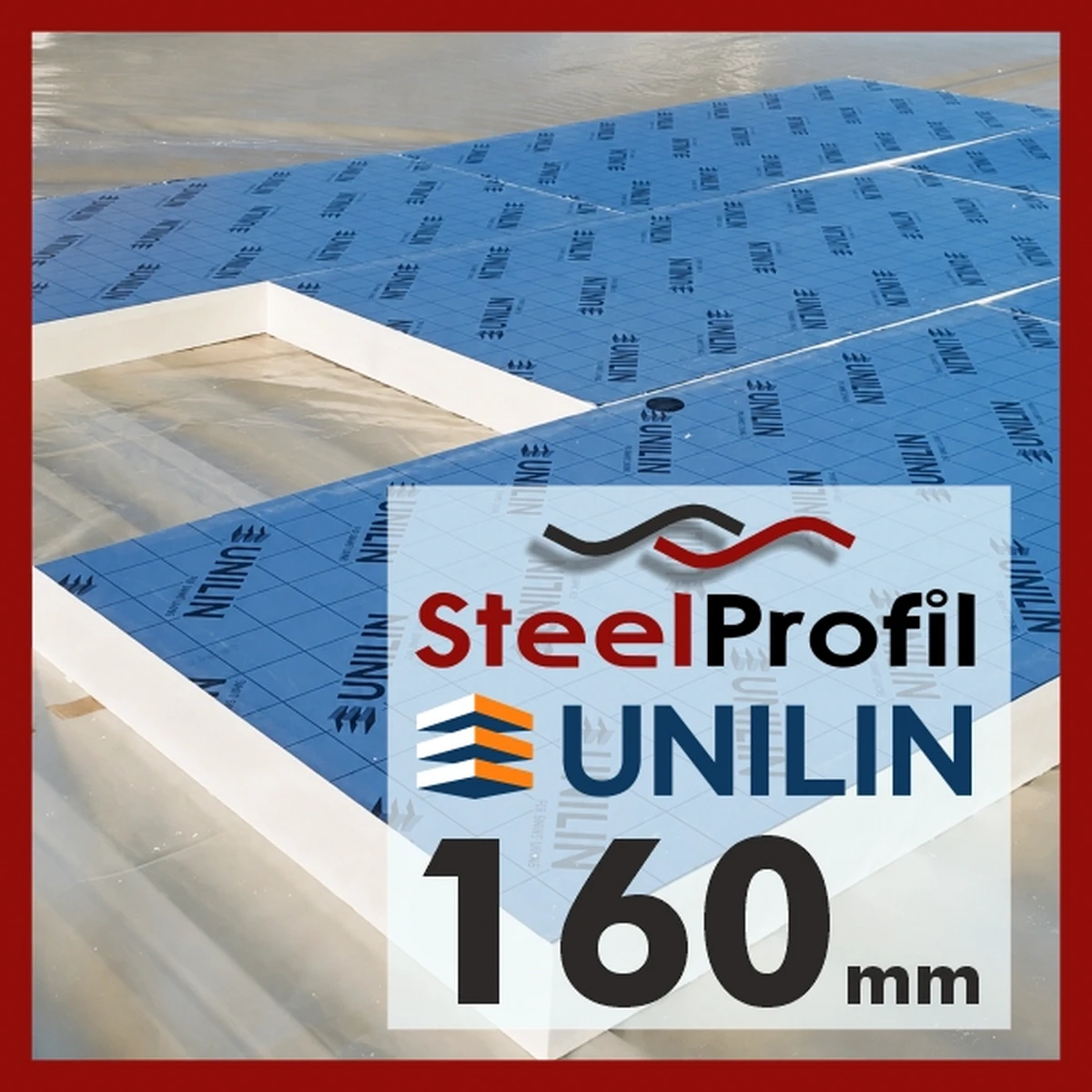



PIR boards and PUR spray foam are polyurethane-based insulation products, but they differ in formulation, form and installation. PIR is commonly supplied as factory-made rigid boards. Spray-applied PUR is available in both open-cell and closed-cell versions, with different thermal and moisture properties. Board thickness is set during manufacture; spray thickness and workmanship must be controlled on site. Choose by the declared thermal conductivity, intended use, moisture design, strength and the fire classification of the actual product and assembly. The names PIR and PUR alone do not establish suitability, smoke production or fire resistance.

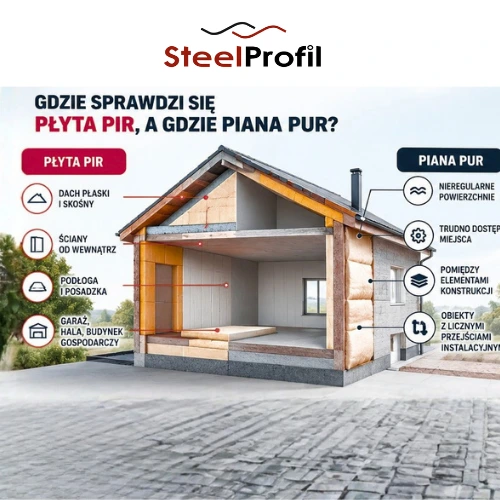
Are PIR and PUR the same material?
Both belong to the polyurethane family, also called PU. Their formulations and the chemical structures formed during manufacture differ. PIR contains isocyanurate structures that affect its behaviour at elevated temperatures. This chemical distinction should not be confused with the difference between a board and an on-site spray application.
- PIR boards are usually rigid factory-made products with specified facings and dimensions.
- PUR spray foam is applied on site and may be open-cell or closed-cell.
- Rigid PUR boards and panels also exist.
How should fire performance be compared?
Compare declared reaction-to-fire classifications and, where relevant, tested fire resistance for the complete assembly. Facings, thickness, joints, fixings and surrounding layers matter. A general comparison of polymer names cannot establish flame spread, smoke production or a required EI/REI rating. Use the documentation for the actual products and intended installation.
Where are PIR boards particularly useful?
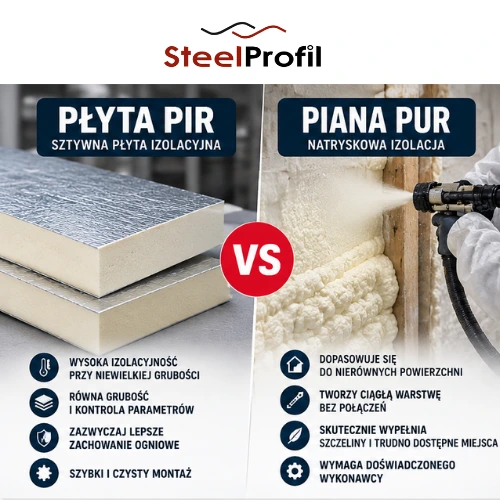
PIR boards are particularly useful where the project needs:
- uniform, controlled insulation thickness;
- high thermal performance in limited space;
- high compressive strength;
- rapid installation over large, regular surfaces;
- verifiable factory-declared product properties;
- roof, floor, terrace or wall insulation in accordance with a specified system.
PU insulation, including PIR, is used in roofs, walls, floors, composite panels and industrial buildings.
Aluminium-faced PIR boards may be particularly suitable for:
- over-rafter insulation;
- flat roofs;
- floors and floor constructions;
- internal wall insulation;
- garages and outbuildings;
- projects where every centimetre of insulation thickness matters.
The final application must follow the technical data sheet for the specific board.
Where can PUR spray foam have an advantage?
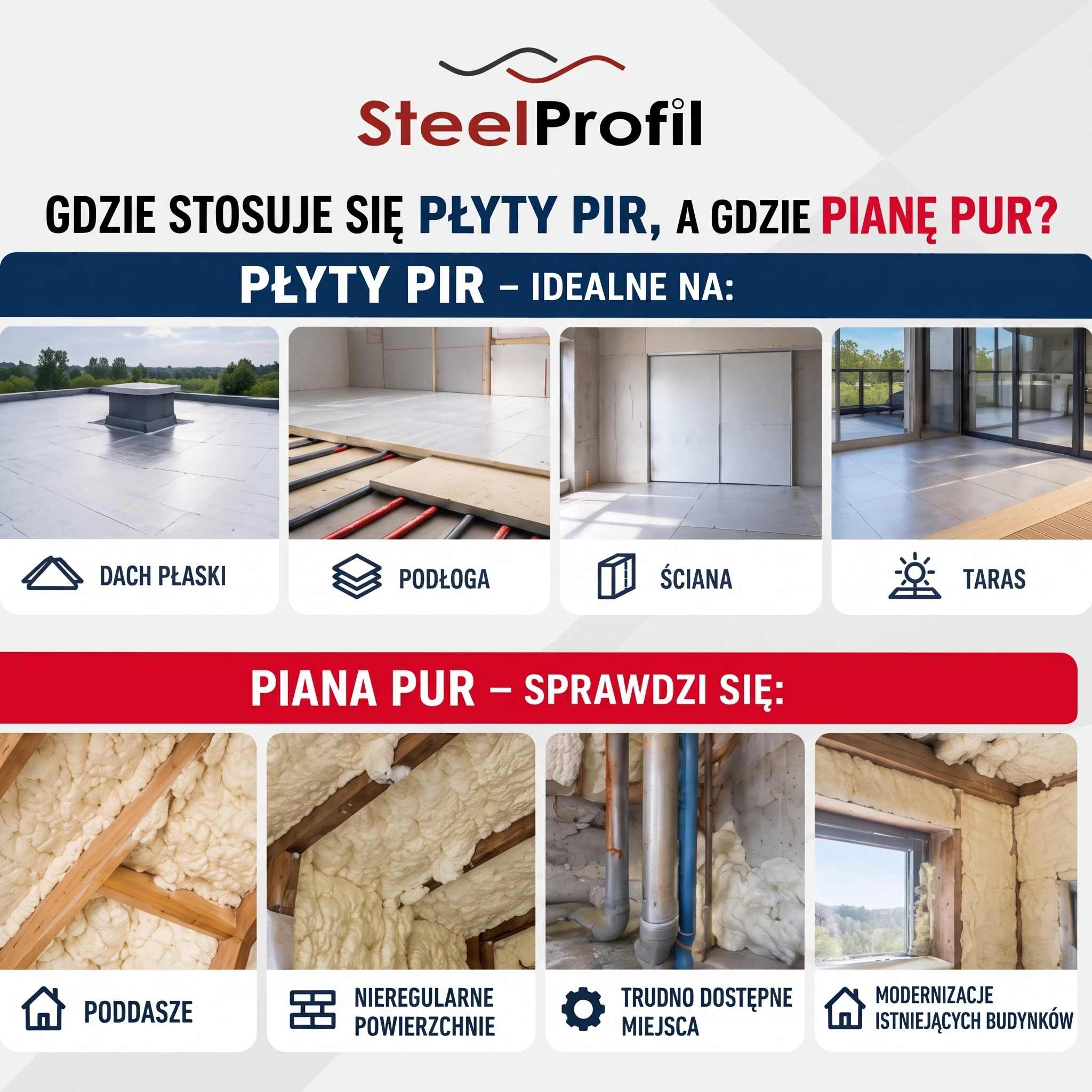
Spray foam can be practical on complex surfaces, around numerous services and gaps, or in hard-to-reach spaces. When correctly applied, it conforms to the substrate and can reduce the number of joints associated with board insulation.
It is often considered for:
- irregular roof slopes;
- insulation between structural members;
- awkward corners and recesses;
- surfaces with many service penetrations;
- refurbishing existing buildings.
The result depends more strongly on workmanship. Check the spray thickness and uniformity, substrate preparation, temperature and humidity during application, and the documentation for the system used.
PIR boards from stock at SteelProfil
SteelProfil offers aluminium-faced PIR insulation boards in various thicknesses and formats. Before ordering, specify the intended application, required thickness, area and delivery postcode or your chosen collection branch.
Ask about materials for your project
Tell us which material you need, the quantity and delivery location. The SteelProfil team will help prepare an offer for your inquiry.
Phone: +48 500 409 109
REQUEST A QUOTE!