At a glance
Roof insulation should be selected for the complete roof construction, its use and the required thermal performance. Mineral wool, cellulose, EPS, XPS and rigid foam boards offer different properties and installation methods. The lowest quoted thermal-conductivity value is useful information, but it does not settle every moisture, fire, acoustic or structural question. This guide outlines the material families discussed in the source and explains how to compare them without assuming one solution is best in every season. Roof insulation can influence heating and cooling demand, while the actual result also depends on the rest of the building and its details.
Insulation families and locations
The source lists EPS and XPS, stone wool, glass wool, cellulose, PUR foam, PIR-based products and PIR boards. EPS and XPS are different polystyrene products; stone and glass wool are mineral-wool families. The precise product and its intended position in the roof must be identified.
Other options mentioned include cork, perlite, natural wool, straw, reflective insulation products and wood-wool or wood-magnesite boards. These do not all serve the same purpose or offer interchangeable performance. Some require a particular complete assembly rather than being substituted directly for a conventional insulation layer.
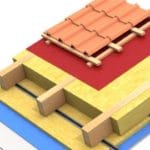
Insulation may be placed within the roof structure or above it in a designed over-rafter system. Above-rafter insulation is not limited to mineral wool on boards. Select the supporting layers, insulation and moisture-control details together.
GET A QUOTE FOR INSULATION!
What does thermal conductivity tell you?
Thermal conductivity, λ, describes heat conduction through a material under stated conditions. Lower values generally mean less conduction for the same thickness under comparable conditions. Use the declared data of the exact product rather than treating one number as constant for every PIR, mineral-wool or other insulation product.
The original article compared a reference temperature of 10°C with a roof heated to 50°C. It then claimed that mineral wool’s performance deteriorates markedly while PIR changes only minimally. Those broad claims do not establish the comparative performance of all products or a building’s summer cooling demand. Do not derive an energy saving from them without appropriate product data and a complete assessment.
Thermal resistance of an insulation layer and heat transfer through an entire roof are different measures. Thickness, joints, thermal bridges, ventilation and other layers matter. Compare the actual roof design for winter and summer conditions rather than declaring a universal material winner.

Compare documented products and complete systems
Manufacturers offer mineral-wool mats, glass-wool products, cellulose and other loose-fill systems, perlite-based boards, rigid PUR/PIR boards and complete roof assemblies. The source named product examples including EasyTherm composite boards, Thermano Roof, termPIR and IZOPROOF. These are examples of distinct products, not interchangeable names for one insulation material.
The original January 2023 text quoted λ = 0.023 W/(m·K) for its Thermano Roof example. That value must not be transferred to every Thermano variant or the PIR market. Check the current declaration for the exact product and thickness. Facings, intended application and ageing-related declarations can differ.
Obtain the relevant documents and consider moisture behaviour, fire classification, installation and the complete assembly alongside thermal data. A properly selected PIR product may be a useful option, but a promise of unchanged performance in every condition is not a substitute for specification and suitable workmanship.