







Steel roofing: coatings and manufacture
At a glance
Steel roofing commonly starts with thin steel strip that is protected, formed and cut into the required product. Metallic coatings and optional organic finishes have different protective and appearance functions. The profile, steel grade, thickness and complete installation determine suitability for a roof or façade. This guide explains those layers and the route from coil to finished sheet. It also corrects two common oversimplifications in the December 2009 source: zinc does not literally refill every scratch, and forming is not a process with no deformation. Cut edges and damaged coatings must be treated according to the actual product requirements.
Metallic protection and cut edges
Zinc-based coatings provide barrier protection and sacrificial electrochemical protection under suitable conditions. This is not spontaneous replating of every exposed area or a guarantee that any scratch will heal.
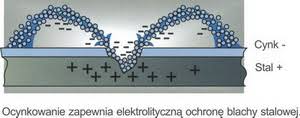
The illustration describes the protective principle; it does not establish a universal no-maintenance rule. Use the specified cutting method, remove swarf and follow instructions for exposed edges or damaged finishes. Cold cutting alone does not prove that every cut edge can always be left untreated.
Corrosion products can contribute to protection, but their behaviour depends on exposure and coating. Compare the specified metallic coatings and any additional organic coatings for the intended environment.
Organic finishes and appearance
Polyester, plastisol, polyurethane and PVDF are examples of finish families. They differ by product in thickness, texture, gloss, colour range and documented performance. Not every range offers every RAL colour.
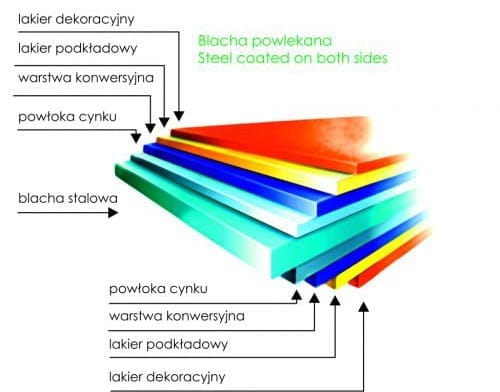
Metallic-coated sheet without an organic topcoat still has specified uses, including some cladding and structural products. It has not universally disappeared or become suitable only for purlins.
From coil to finished roofing
Steel strip is unwound, formed to the required profile and cut to length. Roll forming is important for trapezoidal sheets and other profiles; some tile-effect products also use transverse forming or pressing steps. Forming changes shape through deformation and must remain compatible with the substrate and coatings.
Manufacturing sandwich panels includes additional core and bonding processes. It is not merely the same sheet-forming line producing a thicker product.
After inspection and packing, sheets need appropriate transport, storage and competent installation. The related guide to steel production describes the preceding material stages.
Ask about materials for your project
Tell us which material you need, the quantity and delivery location. The SteelProfil team will help prepare an offer for your inquiry.
Phone: +48 500 409 109
REQUEST A QUOTE!