







At a glance
Roof underlays and vapour-control layers perform different tasks within a roof. An underlay beneath a covering can help manage wind-driven water, while an internal vapour-control layer limits moisture movement from the occupied space according to the design. Products described simply as foil or membrane are not interchangeable. Vapour permeability, water resistance, strength and permitted installation conditions matter more than the name alone. This guide explains the main distinctions and why the complete roof build-up, including ventilation and joints, determines the choice. A moisture-resistant insulation material does not by itself remove the need to assess vapour control.
Low- and high-permeability sheets
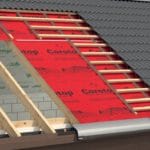
Roofing products include low-permeability underlays, more vapour-open underlays and internal vapour-control layers. They are selected for different positions and functions.
A low-permeability underlay may require a ventilated space beneath it. A highly vapour-open underlay may permit contact with insulation in a specified construction, but that does not mean ventilation and moisture assessment can be omitted from every roof. Follow the product’s instructions and the full design.
Vapour-control layers are used on the appropriate side of the insulation to manage moisture from inside. Their need and performance depend on the assembly and internal conditions, not solely on whether the insulation absorbs water.
What does “roof membrane” mean?
The term covers different products. Many pitched-roof underlays use polymer-based layers and are described as breathable or vapour-open. Lighter and heavier versions differ in handling and other properties, but mass alone does not prove strength or durability. Flat-roof waterproofing membranes are a separate functional category.
GET A QUOTE FOR STEEL SHEETS!
Choose by function, not the marketing label
The underlay, internal vapour-control layer and exposed waterproofing layer cannot be chosen as substitutes just because they all arrive in rolls. Compare the declared properties, permitted supports, joints, exposure limits and compatibility with the roof system.
The original article of 20 December 2022 named several product families. Examples included Red Strong, Ultra and Power underlays; Variant, Active Control and Reflex vapour-control products; Tyvek variants; Verso and Ventia; Izol Bud and Izolflex; and Delta systems. The actual product and version must be checked, because a family name alone does not establish its function.
The source also referred broadly to polymer sheets and to Monarplan. An exposed flat-roof waterproofing product must not be classified as a breathable pitched-roof underlay. Choose the precise system for its documented role rather than copying a mixed list of products into a specification.
Films used at façades or foundations likewise have their own requirements. A manufacturer offering several kinds of sheet does not make those sheets interchangeable.

Make the roof build-up explicit
Ask the supplier for the exact product documentation and confirm how the layers and connections work together. Appropriate underlays and vapour-control details help protect the roof; a general recommendation of a brand or retailer does not replace that check.